
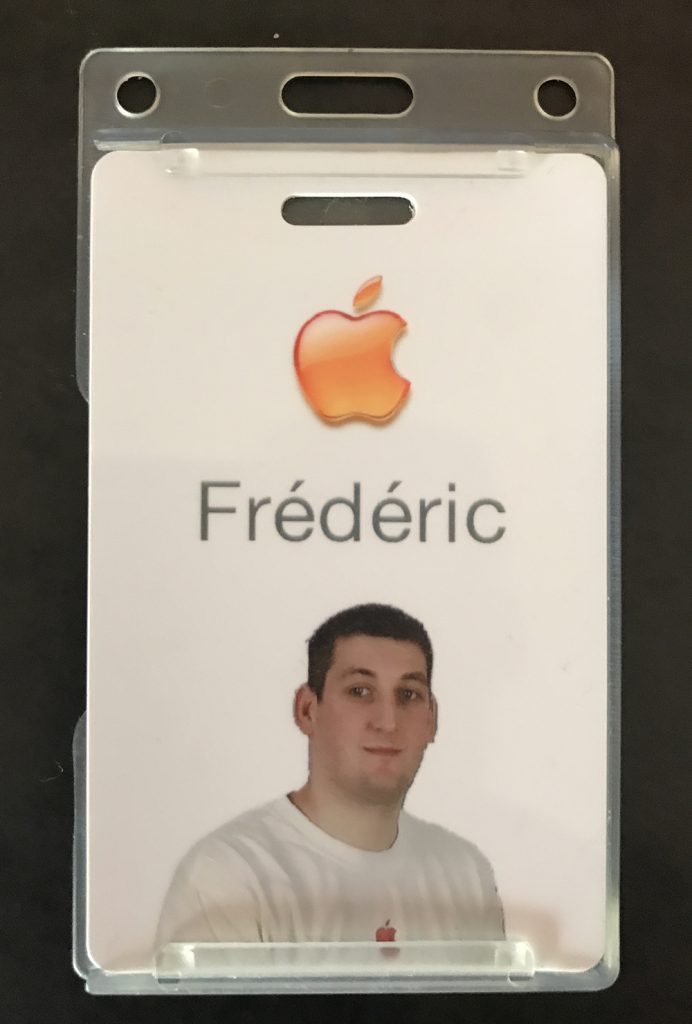
After 23 years of professional career as a developer on MacOS & iOS, I figured it would be interesting to take stock and talk about the apps and projects I've worked on.
GroupEchange
It all starts in January 1999; I'm supposed to do my engineering degree internship at Epita. Like all my classmates, I land an internship at some random Parisian IT services company, in the "Systems and Networks" division. Obviously, I'm bored and I quit after a month. I'm immediately hired full-time at a company in Les Ulis, two steps from Apple France, specialized in Mac-world training. The technical director, Jean-Luc Farat — an old-school telecom engineer, ex-Apple France and inventor of the Apple Djinn — had spotted me because I had developed a shareware Mpeg-2/DVD player for Mac.
At GroupEchange, I'm in charge of system, network, and developer training. At the same time, I maintain the code for the Wanadoo Internet installers. It was built with Metrowerks PowerPlant in C++. There were countless installers for dial-up, ADSL, white-label stuff. Basically, a mess; I understand why the previous dev ended up quitting.
1999 is also the first year I attend WWDC. Back then, despite the iMac launch a year earlier, the Mac market is tough and we're barely 2,000 developers attending. On the other hand, Silicon Valley is buzzing and it's a real shock to find myself there for two weeks. I remember crashing at a classmate's place who was interning at Netscape: paradise.
I spent a few months at GroupEchange. Dev-wise, nothing very interesting happened, but it allowed me to meet many people at Apple France and gave me a foothold in the Apple professional world.
Cryo Interactive
Late 99, in the middle of the euphoria where simply claiming you knew how to code got you 5 job offers a day, I leave for Cryo Interactive, a video game publisher founded by Philippe Ulrich, to head up the Mac division. A pompous title for the fact that I'll be handling all Mac game ports alone. I join the technical direction team working on cross-platform C++ game engines, Omni 3D, a QuickTime VR–like.
At Cryo, the atmosphere is wild: video games, Internet bubble and easy (virtual) money, the move to 35-hour weeks, crazy turnover with going-away and welcome parties almost daily. We spend more time laughing than working, but we still make solid progress. I even managed to find an intern to help me — a certain Wilfried de Kerchove de Dentergheim I had crossed paths with at the Epita Mac club. I stayed exactly 52 weeks at Cryo and we managed to port to Mac (OS 9 at the time) the new Cryogen game engine (2D, 3D, video, audio, controls) and the following games:
- Atlantis 2
- Atlantis 3: The New World
- Aztec: The Curse in the Heart of the City of Gold
- Egypt 2: The Heliopolis Prophecy
- Wealth of the World (never released)
And to maintain the older titles:
- Atlantis: The Lost Tales
- Egypt 1156 B.C. – Tomb of the Pharaoh
- The Louvre
- Versailles
Mid-2000, the Internet bubble bursts and the video game market shows signs of weakness. The Cryo Network adventure and its IPO turn into a catastrophe. Time to look elsewhere. As it happens, I'm contacted by a French company specialized in Mac security and antivirus software (yes, that exists; I'm talking about the antivirus, not the virus).
Intego
Change of atmosphere — at Intego it's noticeably less fun than Cryo, but at least the company looks serious. I'm hired to develop a firewall for MacOS X, which has just come out; ah, memories of 10.0.4. You needed real courage to develop a kernel extension back then: one bug, one crash, one reboot. It was long and painful, but very interesting since everything had to be discovered with Apple's new system. Since the boss thought I was getting bored, he also asked me to write an antivirus for Palm. I think we had one virus signature in the database. Mid-2001, for personal and professional reasons, I decide to leave.
Lekya
I set up my own little company and start looking for contract work. As it happens, someone from Cryo calls me and offers me the Atlantis 4 Mac port. Not the challenge of the century, but I know the engine code well and it'll be easy money. Well, of course the third payment cheque was mailed just yesterday and I should receive it tomorrow. Or the day after. Or never. Cryo is in liquidation and I'll never see that money. For the record, Cryo's assets were transferred to Dreamcatcher, Cryo's US subsidiary, and the game does ship. Pure rip-off.
Looking for another contract, I'm offered to port the game Zombinies to Mac. I've become France's specialist in Mac game porting and it's not over yet. I do a quick 2-week port to get a prototype going — the company goes under, and I don't get paid.
January 2002, a friend calls me because he's looking for a Mac dev for a secret project at an unnamed company. So I head to the interview a little skeptical.
Apple
In an office in the 8th arrondissement, Jean-Marie Hullot — inventor of Interface Builder, ex-Next, and friend of Steve Jobs — has just set up a new team at Apple. They're already about ten developers, working on 2 projects: iCal and iSync. The position offered to me is mobile Bluetooth developer. It's 2002 and the first phones — not even 3G yet — are starting to embed a new wireless technology, Bluetooth. Nobody knows how to make a Mac talk to a phone, and my predecessor apparently failed. My job will be to develop the data sync modules (Contacts and Calendar among others) between Mac and phones (Sony Ericsson T39 & T68, Nokia Symbian, Sony P800/P900, Motorola). Fun fact: at that time, Bluetooth stacks were still young and full of security holes. Basically, you could grab everything stored on a phone without any authorization.
iSync and iCal are announced and demoed by Steve Jobs at Macworld in July 2002 in New York. Brief stressful moment when Steve runs the sync between his Mac and his T68. Phew, it worked! I've included the keynote video below — the iSync demo is at 1h24.
This is Apple's first significant experiment in mobile telephony.
Late 2003, the Paris team hires a few more people and starts a new mobile-related project: Typhoon. More than 20 talented developers will work on this project for 2 years and finish it. It will be cancelled a few days before its presentation in late 2005, with no explanation. The explanation arrives in January 2007 with the iPhone unveiling. Contrary to rumors going around in France, the Paris team never created the iPhone. In fact, our team was used to study the field of possible uses for early smartphones (notably under SymbianOS) and data synchronization with a Mac. I won't say more, because even though the NDA of that era has expired, Apple has never communicated about Typhoon — and anyway, with the iPhone, this project had become completely obsolete.